
How Is Urethral Stricture Diagnosed? Tests Your Doctor May Recommend

Brahma Ayurved
Ayurvedic Urology Center
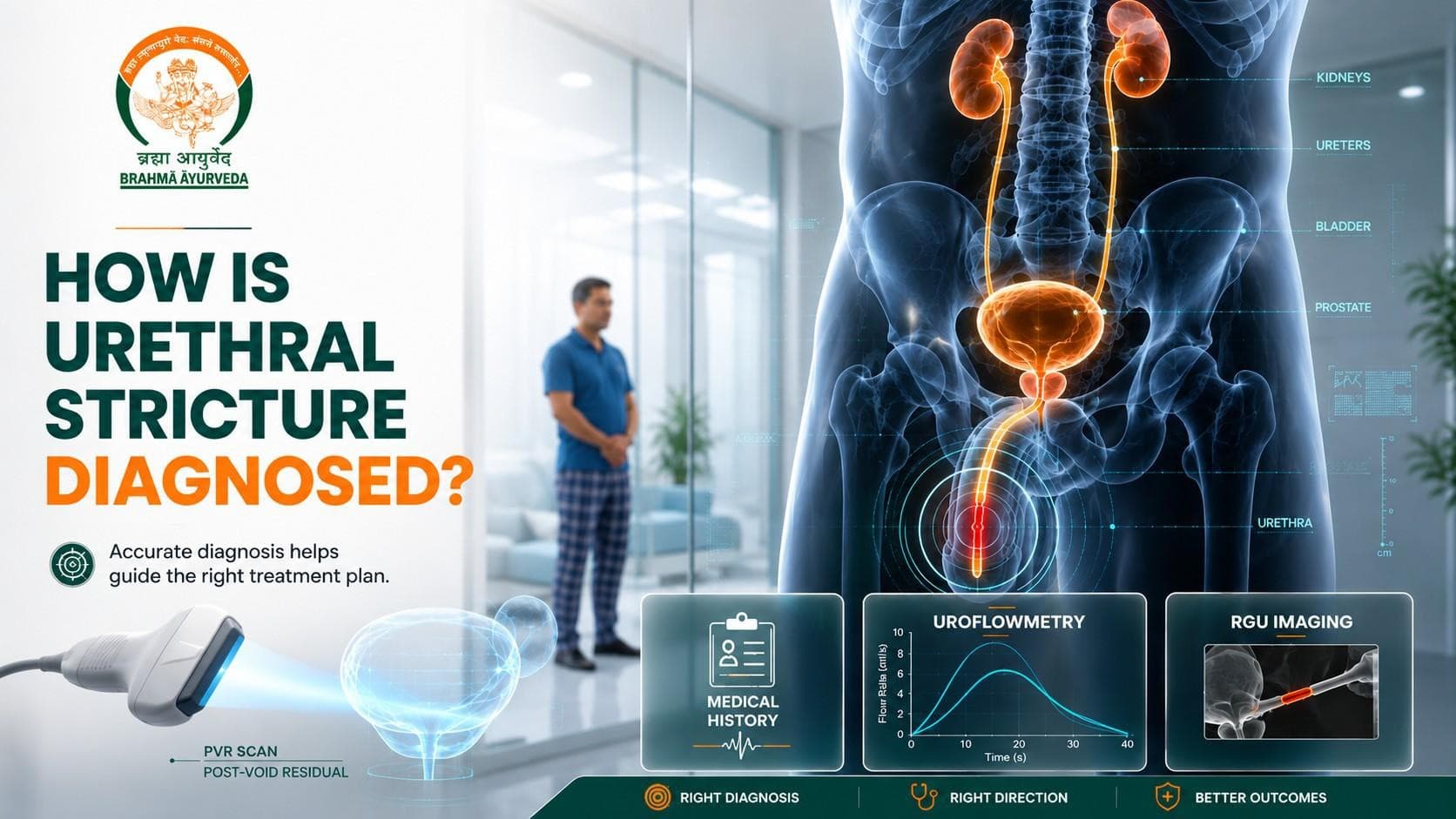
If you find your urine stream weaker, you have to strain to urinate or your bladder never feels empty, you may be wondering why.
A urethral stricture is one possible reason, but it isn’t the only one.
Several urinary conditions can produce similar symptoms, which is why doctors don’t diagnose a urethral stricture based on symptoms alone. Instead, they combine your medical history, examination findings, and a few appropriate investigations to understand what’s actually happening.
If you are not sure whether your urinary symptoms could be related to a urethral stricture, you may find it helpful to read about the common symptoms of urethral stricture before continuing.
The purpose of diagnosis isn’t simply to confirm a urethral stricture. It’s to find the exact cause of your urinary symptoms so that the right treatment can be planned.
The First Consultation Is Often More Important Than People Think
Many patients expect investigations to begin as soon as they enter the clinic. In reality, the first consultation usually starts with a detailed discussion.
Your doctor will want to understand when the symptoms began, how they’ve changed over time, and whether anything in your medical history could be related. It helps the doctor narrow down the possible cause. You can also learn about the causes of urethral stricture and how they may affect the urinary tract.
You may be asked questions such as:
- Has your urine flow gradually become weaker?
- Do you have to wait before urine starts flowing?
- Do you need to strain while urinating?
- Do you often feel that your bladder isn’t completely empty?
- Have you ever had a urinary catheter?
- Have you undergone urinary or prostate surgery?
- Have you had repeated urinary infections?
- Have you experienced a pelvic injury or accident?
These questions may appear simple, but they often provide important clues. In many cases, they also help determine which investigations are actually necessary.
Physical Examination
After discussing your symptoms, your doctor may perform a physical examination.
This may include checking the lower abdomen to see whether the bladder feels full after urination. Depending on the situation, an examination of the genital area may also be advised to look for signs of previous injury, scarring, or skin conditions that can affect the urethra.
Not every patient requires the same examination. It depends on the symptoms and the doctor’s clinical assessment.
Why Is Uroflowmetry Commonly Recommended?
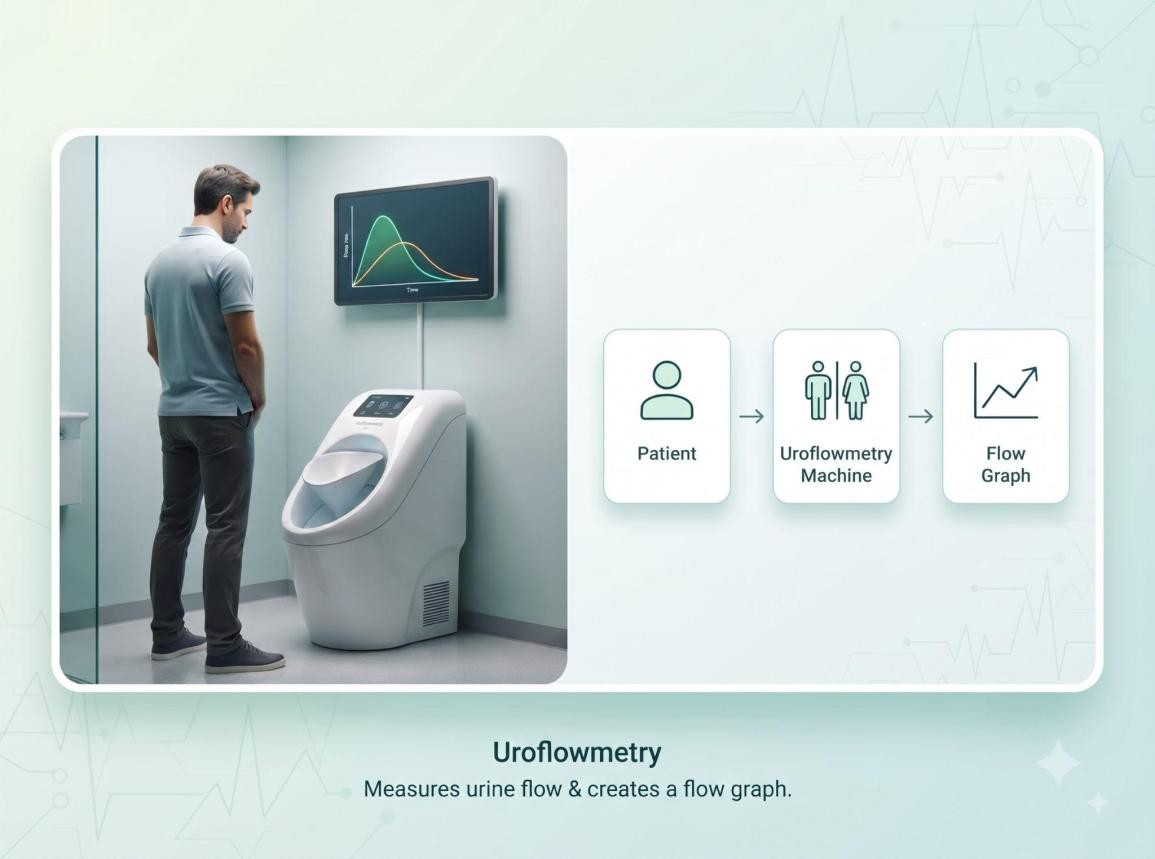
One of the first investigations advised when a urethral stricture is suspected is uroflowmetry.
The test is straightforward. You’ll be asked to pass urine into a special machine instead of a regular toilet. The machine measures the flow of urine and draws a graph for the doctor to see.
It helps measure:
- Maximum urine flow rate
- Average urine flow rate
- Total urine volume
- Overall flow pattern
A healthy urine stream usually produces a smooth, bell-shaped curve. If the flow is slow or the pattern looks flattened, it may suggest that urine is not passing through the urinary tract as freely as it should.
It’s worth remembering that uroflowmetry does not confirm a urethral stricture by itself. It simply tells the doctor that further evaluation may be needed.
What Is a Post-Void Residual (PVR) Scan?
After you’ve emptied your bladder, your doctor may want to know whether any urine is still left behind.
That’s where a Post-Void Residual (PVR) scan becomes useful.
This is a quick ultrasound performed immediately after urination. It measures the amount of urine remaining inside the bladder.
A small amount of residual urine can be normal. However, if a significant quantity remains, it suggests that the bladder is not emptying efficiently.
A high PVR does not automatically mean a urethral stricture. Similar findings can also be seen in conditions such as an enlarged prostate or problems affecting bladder function. For this reason, the result is always interpreted together with your symptoms and other investigations.
Retrograde Urethrogram (RGU): One of the Most Helpful Investigations
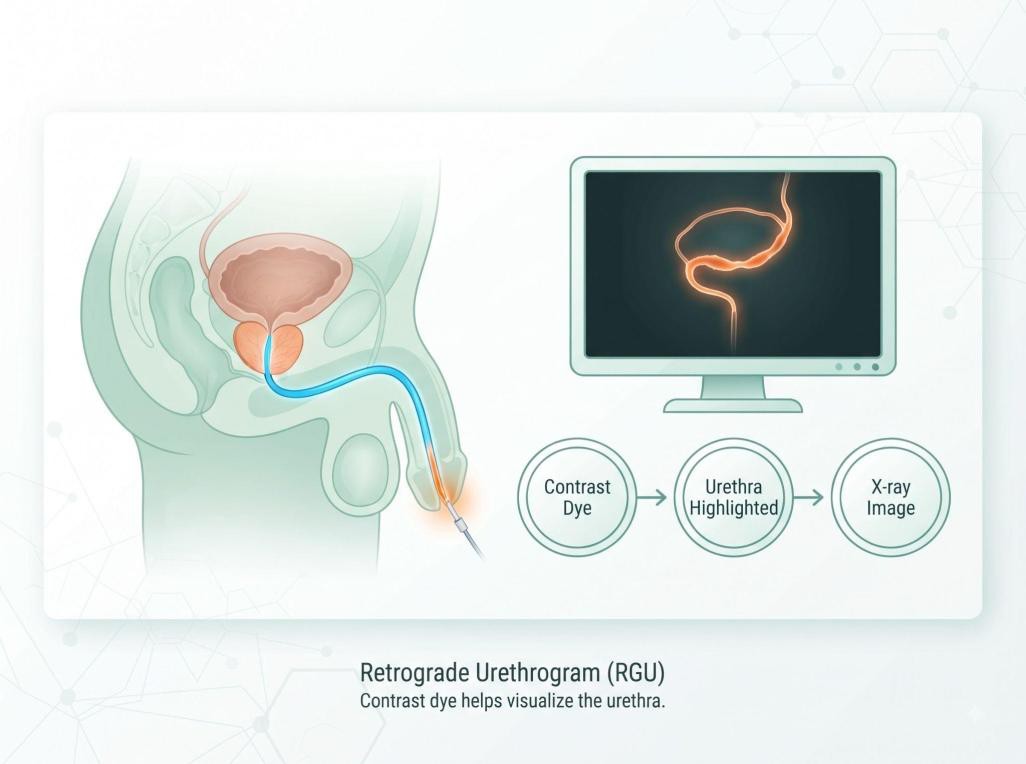
If the initial assessment suggests a urethral stricture, your doctor may recommend a Retrograde Urethrogram (RGU).
An RGU is an X-ray study that allows the urethra to be seen clearly. During the procedure, a contrast dye is gently introduced into the urethra before the images are taken.
The investigation helps answer several important questions:
- Is there a urethral stricture?
- Where is it located?
- How long is the narrowed segment?
- How severe is the narrowing?
Once a urethral stricture is confirmed and its location, length, and severity are understood, the doctor can recommend the most suitable treatment for urethral stricture based on the individual’s condition.
Not Every Patient Needs Every Investigation
A common misconception is that every person with urinary symptoms requires the same set of tests.
That isn’t the case.
The investigations recommended for one patient may not be necessary for another. The decision depends on factors such as:
- Your symptoms
- Medical history
- Previous treatment
- Examination findings
- Results of earlier investigations
In many patients, a combination of medical history, uroflowmetry, PVR, and RGU provides enough information to reach a diagnosis.
Investigations such as Micturating Cystourethrogram (MCU) or cystoscopy are not routinely performed in every case. They are usually recommended only when additional information is required or when the treating doctor feels they may influence further evaluation or treatment planning.
Are MCU and Cystoscopy Needed for Everyone?
The short answer is no.
People often assume that every patient with urinary symptoms needs every available investigation. In practice, that’s rarely the case.
Micturating Cystourethrogram (MCU)
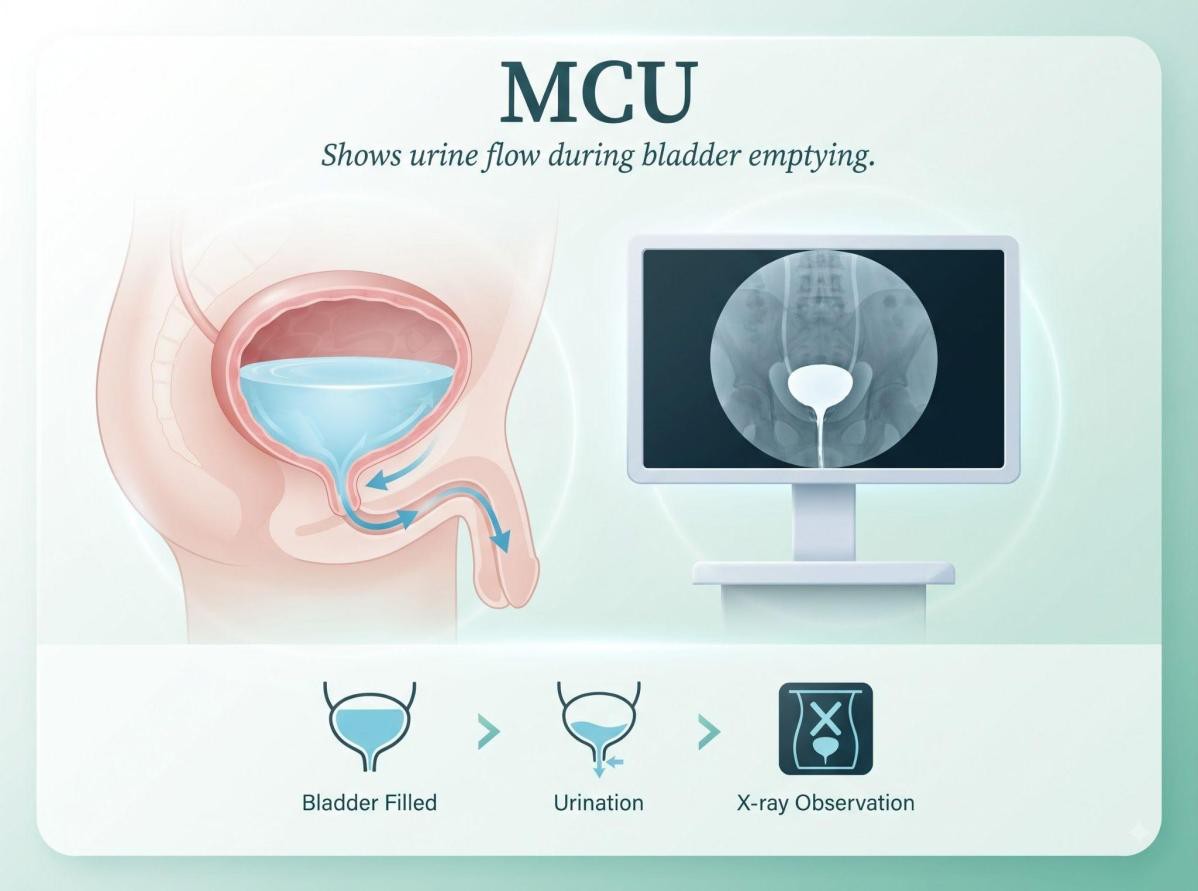
An MCU is a specialised X-ray performed while the bladder is being emptied. It helps doctors understand how urine flows through the lower urinary tract during urination.
However, this investigation is not routinely advised for every patient with a suspected urethral stricture. It is usually recommended only when the doctor feels additional information is needed to better understand the urinary tract or to plan further management.
Cystoscopy
A cystoscopy uses a thin camera to look inside the urethra and bladder.
Although it can provide valuable information, it is not required in every case. Depending on the patient’s history, previous treatment, imaging findings, and symptoms, the treating doctor may or may not recommend it.
In many patients, the diagnosis can be made without performing a cystoscopy.
Key Diagnostic Tests at a Glance
| Test | Method | Diagnostic Value |
|---|---|---|
| Uroflowmetry | Non-invasive voiding test | Measures urine flow speed and pattern to verify obstruction. |
| Post-Void Residual (PVR) | Abdominal ultrasound scan | Checks how much urine remains in the bladder after peeing. |
| Retrograde Urethrogram (RGU) | X-ray imaging with contrast dye | Maps the exact location, length, and depth of the scar tissue. |
Other Tests That May Be Recommended
Sometimes, your doctor may suggest a few additional investigations. These tests do not diagnose a urethral stricture directly, but they help assess your overall urinary health and identify associated problems.
These may include:
- Urine Routine Examination – to check for infection, blood, or other abnormalities.
- Urine Culture – if a urinary tract infection is suspected.
- Ultrasound (KUB) – to evaluate the kidneys, bladder, and post-void residual urine.
- Blood Tests – if there is concern about kidney function or infection.
Not every patient needs all of these investigations. They are recommended only when clinically appropriate.
Why Diagnosis Should Always Come Before Treatment
It can be tempting to focus on treatment as soon as symptoms appear. However, treating a condition without understanding its cause may not give the desired results.
For example, two people may complain of a weak urine stream. One may have a urethral stricture, while the other may have an enlarged prostate or a bladder problem. Although the symptoms appear similar, the treatment approach is completely different.
This is why doctors first identify the underlying cause before discussing management options.

Accurate diagnosis also helps determine:
- Whether a urethral stricture is actually present
- The location and length of the narrowing
- Whether there are associated urinary problems
- Which treatment approach is most appropriate for the individual patient
Diagnosis in Ayurvedic Practice
In Ayurveda, diagnosis is not limited to test reports alone.
Along with modern investigations, an Ayurvedic physician also considers the patient’s symptoms, medical history, overall health, and individual constitution before planning treatment.
At Brahma Ayurveda, patients are encouraged to share all previous reports, imaging studies, and treatment history during consultation. Reviewing this information helps the treating doctor understand the condition more clearly and recommend a personalised treatment plan when appropriate.
The exact investigations required may vary from one patient to another. The decision is always based on clinical judgement rather than a fixed checklist.
Frequently Asked Questions
1. Can urethral stricture be diagnosed without tests?
Symptoms may raise suspicion, but they are usually not enough to confirm the diagnosis. Appropriate investigations help identify the actual cause of urinary symptoms.
2. Is uroflowmetry painful?
No. Uroflowmetry is a simple, non-invasive test. You only need to pass urine into a specialised machine.
3. Does a high PVR always mean urethral stricture?
No. A raised PVR indicates that the bladder is not emptying completely, but several conditions can cause this. Your doctor will interpret the result along with your symptoms and other findings.
4. Is RGU considered an important investigation?
RGU is one of the most useful investigations for identifying the location and length of a urethral stricture and often plays an important role in treatment planning.
5. Will every patient need a cystoscopy?
No. Cystoscopy is recommended only in selected cases when additional information is required. It is not a routine investigation for every patient.
6. Can urinary symptoms be caused by something other than a urethral stricture?
Yes. Similar symptoms may also occur due to urinary tract infections, enlarged prostate, bladder dysfunction, or other urinary conditions. This is why proper evaluation is important.
Final Thoughts
A weak urine stream or difficulty passing urine should never be ignored, especially if the symptoms continue to worsen over time.
Fortunately, diagnosing a urethral stricture is usually a structured process. It begins with a detailed discussion, followed by appropriate examination and investigations based on the individual’s symptoms. Not every patient needs the same tests, and the choice of investigations depends on the doctor’s clinical assessment.
If investigations confirm a urethral stricture, the next step is understanding which treatment approach is suitable for your condition. This depends on several factors, including the location, length, and severity of the narrowing.
If you’d like to understand how treatment is planned, you can also read about Uttar Basti treatment for urethral stricture and its role in selected patients.
If you already have investigations such as Uroflowmetry, PVR, or RGU, you can share your reports during an online consultation so that they can be reviewed by the treating doctor.