
Uroflowmetry: What Is This Urine Flow Test?

Brahma Ayurved
Ayurvedic Urology Center
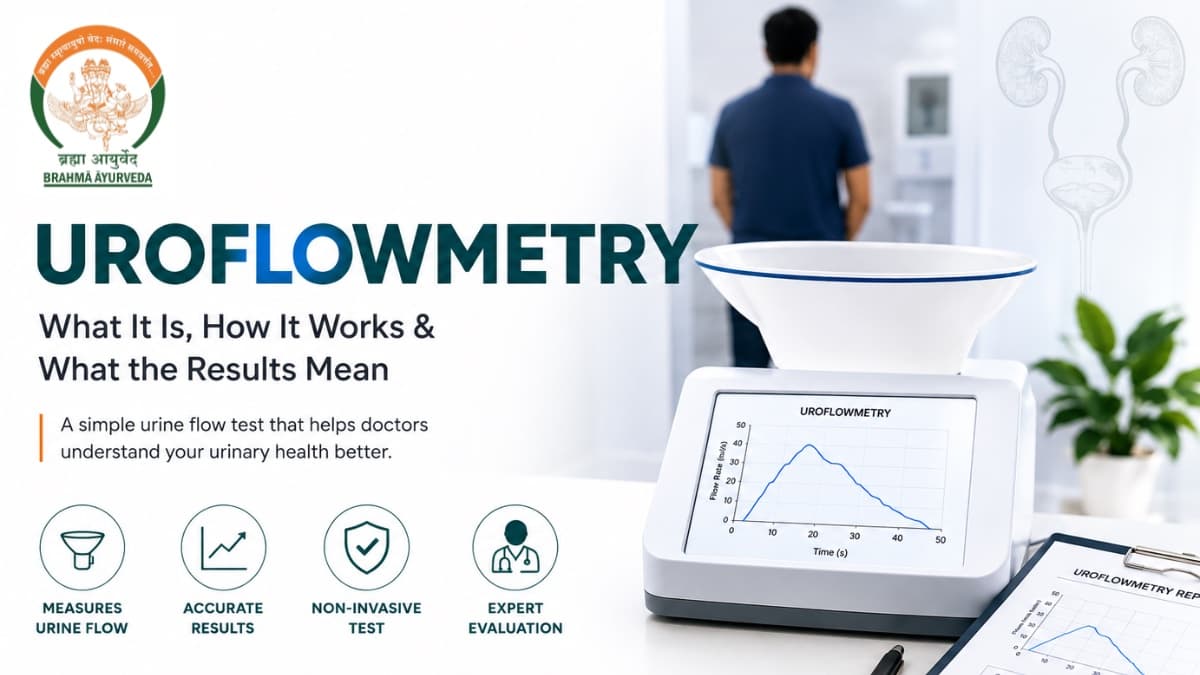
If your urine stream has become weak, slow, interrupted, or difficult to start, your doctor may recommend uroflowmetry. It is a simple test that measures how quickly and how much urine you pass during urination.
For someone who has been dealing with urinary symptoms for months, being asked to urinate into a special machine can seem a little unusual. But the test itself is quite straightforward.
Uroflowmetry can give the doctor useful information about your urine flow and how well the lower urinary tract is emptying. It is often considered alongside your symptoms, medical history and other findings rather than being used as a standalone diagnosis.
If you’re experiencing symptoms such as a weak stream, difficulty starting urination or incomplete bladder emptying, you can also read our guide to the symptoms of urethral stricture.
What Is Uroflowmetry?
Uroflowmetry is a non-invasive urine flow test that records the amount of urine passed and the speed at which it flows.
Instead of collecting urine in a normal toilet, you urinate into a specially designed device called a uroflowmeter.
The machine records information such as:
- How much urine you pass
- How long you take to urinate
- The speed of urine flow
- The pattern of the urine stream
- The maximum flow rate, often called Qmax
The result is usually displayed as a flow-rate graph.
That graph can sometimes tell the doctor more than a single number because the shape and consistency of the flow may also be relevant.
Why Is Uroflowmetry Done?
Uroflowmetry is mainly used when someone has symptoms suggesting that urine is not passing normally.
Your doctor may consider the test if you have:
- A weak or slow urine stream
- Difficulty starting urination
- Straining to pass urine
- Interrupted urine flow
- A feeling that the bladder has not emptied completely
- Frequent or prolonged urination
- Previous urinary tract problems
A reduced flow can have several possible causes. Urethral stricture is one of them, but it is not the only explanation.
Problems involving the bladder, prostate or other parts of the lower urinary tract can also affect the flow.
That is why a uroflowmetry result needs to be interpreted in context.
How Does Uroflowmetry Work?
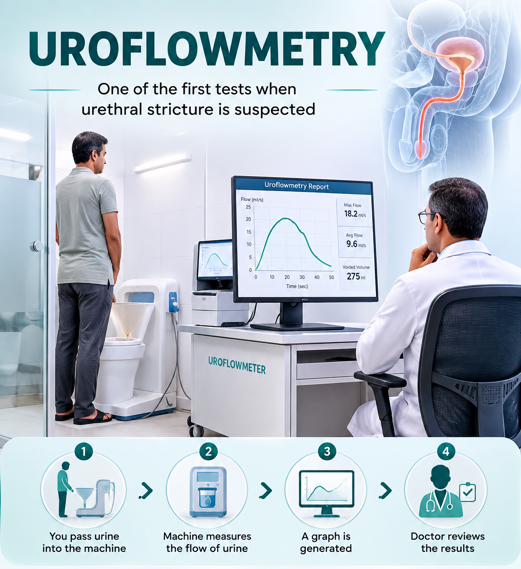
The actual test is usually quite simple.
You will be asked to urinate into the uroflowmeter when you have a comfortably full bladder. The device measures your urine flow while you are passing urine.
You don’t need to do anything special while urinating. The most useful result usually comes from passing urine in your normal way rather than trying to increase or control the stream.
Once you finish, the machine generates a report showing the urine volume, flow rate and flow pattern.
Some clinics may also check the amount of urine left in the bladder afterward using a PVR (post-void residual) bladder scan.
This combination can be useful because it looks at both how urine comes out and whether the bladder has emptied properly.
Does Uroflowmetry Hurt?
No. Standard uroflowmetry is a non-invasive test.
There is normally no catheter involved in the basic urine flow measurement. You simply pass urine into the flowmeter.
For many patients, the main difficulty is psychological rather than physical. Some people find it slightly uncomfortable or embarrassing to urinate while knowing that the machine is recording the flow.
That’s completely understandable.
The important thing is to urinate as normally as possible so the result reflects your usual flow.
Do You Need a Full Bladder?
Usually, you should arrive with a comfortably full bladder, rather than a painfully overfilled one.
The amount of urine passed can affect how useful the result is. European Association of Urology guidance notes that uroflowmetry measurements are ideally interpreted when the voided volume is above about 150 mL, and an abnormal or low-volume result may sometimes need to be repeated.
This is one reason you shouldn’t try to force yourself to hold an excessive amount of urine before the test.
Follow the preparation instructions given by your clinic.
What Does the Uroflowmetry Result Show?
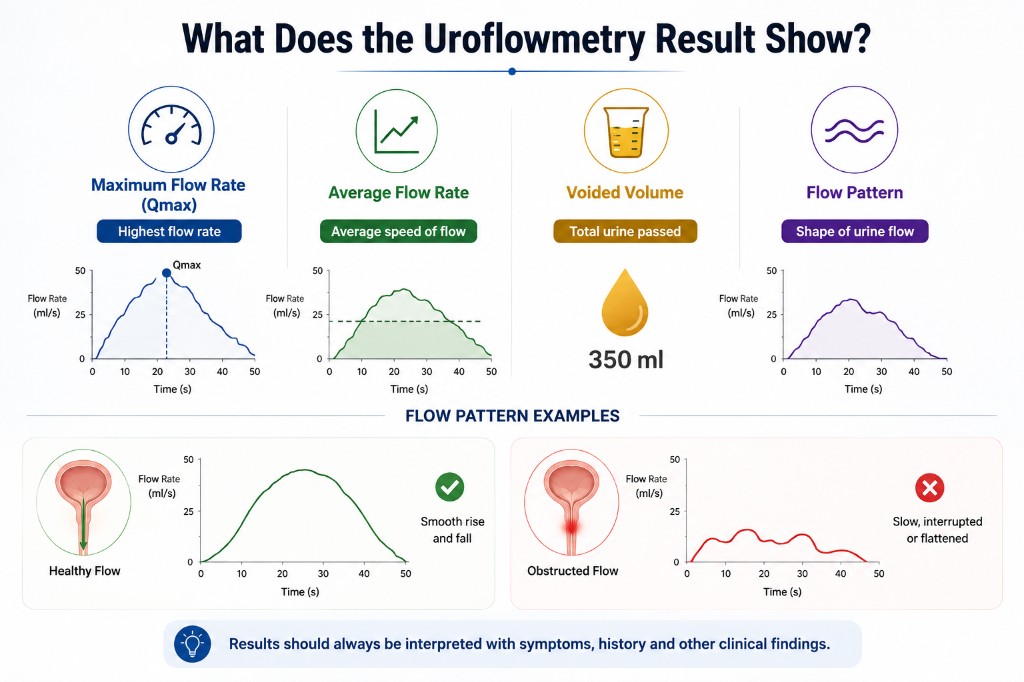
The report usually contains several measurements.
Maximum Flow Rate — Qmax
This is the highest flow rate recorded during urination.
A lower Qmax can be associated with obstruction or poor bladder contraction, but there is no single Qmax value that proves a person has a urethral stricture.
Age, bladder volume, hydration, sex, bladder function and other factors can influence the result.
Average Flow Rate
This represents the average speed of urine flow during the test.
It gives additional information about how urine passed throughout the entire void.
Voided Volume
This tells the doctor how much urine was passed during the test.
The volume matters because a very small void can make interpretation less reliable.
Flow Pattern
The shape of the graph can also be useful.
A healthy flow may rise and fall in a relatively smooth pattern, while an obstructed flow may appear slower, interrupted or flattened.
But again, the graph is a clue, not a diagnosis by itself.
Can Uroflowmetry Diagnose Urethral Stricture?
This is one of the most common questions patients ask.
Uroflowmetry can raise suspicion of a urethral narrowing, but it cannot confirm a urethral stricture on its own.
For example, a low or abnormal flow may occur because of:
- Urethral stricture
- Bladder outlet obstruction
- Prostate-related obstruction
- Weak bladder muscle
- Inadequate bladder volume during the test
- Other urinary tract conditions
If the clinical picture suggests a urethral stricture, the doctor may recommend additional evaluation.
Depending on the individual case, this may include investigations such as RGU (retrograde urethrogram) or other tests. More invasive investigations such as cystoscopy are generally considered when they are clinically useful; they are not required for every patient.
If you want to understand how the complete diagnostic process is approached, read our detailed guide on how urethral stricture is diagnosed.
What Does a Low Flow Rate Mean?
A low flow rate does not automatically mean something serious.
It means that urine is passing more slowly than expected under the circumstances of the test.
The doctor will consider the number together with:
- Your age
- Symptoms
- Voided urine volume
- Flow pattern
- PVR
- Medical history
- Previous urinary procedures
- Other investigation results
For example, someone who passes only a small amount of urine during the test may have a lower flow reading that does not accurately represent their usual urination.
This is why doctors generally avoid interpreting one number in isolation.
Uroflowmetry and Urethral Stricture
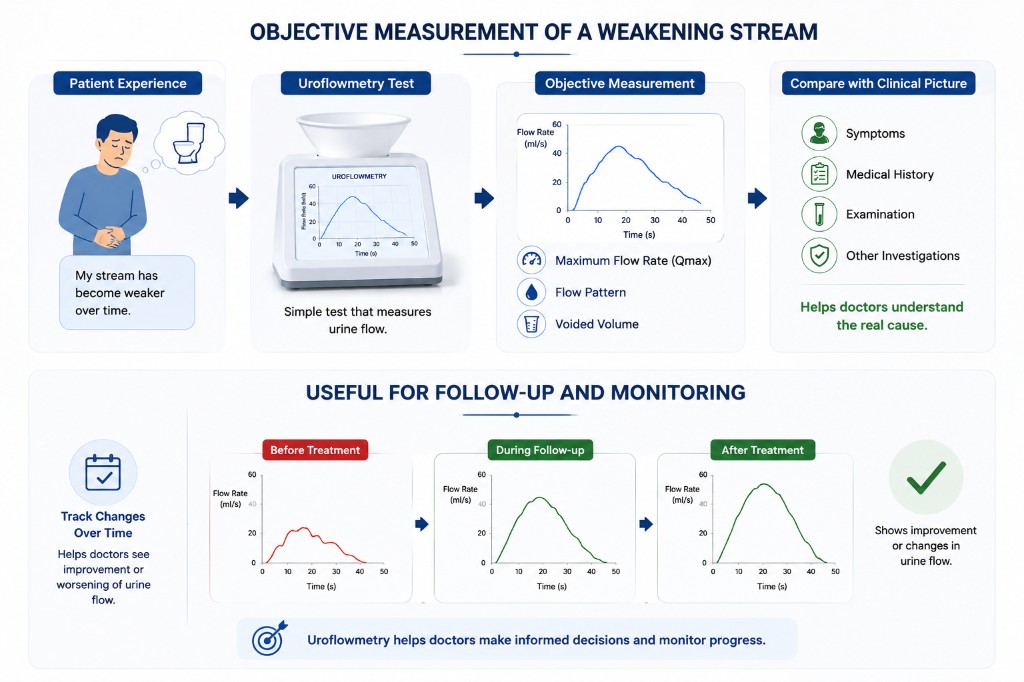
In someone with a suspected urethral stricture, uroflowmetry can be particularly useful for assessing the effect that narrowing may be having on urine flow.
A patient may report that the stream has gradually become weaker. The uroflowmetry graph can provide an objective measurement that can be compared with symptoms and, where appropriate, other investigations.
The test may also be useful during follow-up when the doctor wants to see how urinary flow is changing over time.
However, the result should always be interpreted alongside the rest of the clinical picture.
If you’re interested in understanding what causes urethral stricture, including trauma, catheter-related injury, infection and scar formation, our detailed causes article explains these factors in more detail.
What Happens After Uroflowmetry?
There isn’t one standard next step for everyone.
Your doctor may simply review the result alongside your symptoms.
In other cases, additional assessment may be appropriate.
For example, if the result suggests reduced flow and your symptoms point toward urethral narrowing, the doctor may consider further investigations to understand the location and severity of the problem.
If a urethral stricture is confirmed, treatment is then discussed according to the individual’s condition, including the location, length, severity and previous treatment history.
You can read more about Ayurvedic treatment for urethral stricture if you want to understand the treatment approach offered by Brahma Ayurveda.
Is Uroflowmetry Enough to Decide Treatment?
Usually, no.
A treatment decision should not be based only on the uroflowmetry number.
In clinical practice, the same flow reading can mean different things in different patients.
Doctors therefore consider the complete picture before deciding what further evaluation or treatment may be appropriate.
This is particularly important in urethral stricture because the characteristics of the narrowing matter.
If you already have your uroflowmetry or other urinary investigation reports, you can book an online consultation and share your reports for review.
What Should You Remember?
Uroflowmetry is a simple, non-invasive way of measuring urine flow.
It can help doctors understand whether urine is passing normally and can provide useful information when someone has urinary symptoms.
But one test result should not be used to label someone with a urethral stricture.
A proper assessment considers the symptoms, medical history, examination and other investigations when they are needed.
That approach helps avoid unnecessary tests while also making sure that an important urinary problem is not overlooked.
Frequently Asked Questions
1. Is uroflowmetry painful?
No. Standard uroflowmetry is non-invasive. You simply pass urine into a special flowmeter.
2. Can uroflowmetry detect urethral stricture?
It can suggest that urine flow is reduced or abnormal, but it cannot confirm a urethral stricture by itself.
3. How much urine is needed for uroflowmetry?
A larger voided volume generally makes the result more useful. EAU guidance notes that interpretation is ideally based on a voided volume above approximately 150 mL.
4. Can I eat before uroflowmetry?
Usually, there is no need to fast for a standard uroflowmetry test. Follow any specific instructions provided by your clinic.
5. Do I need to drink extra water before the test?
You may be asked to arrive with a comfortably full bladder, but you should follow your clinic’s instructions rather than drinking an excessive amount of water.
6. What is Qmax in uroflowmetry?
Qmax is the maximum urine flow rate recorded during the test.
7. Does a low Qmax always mean urethral stricture?
No. A low flow rate can have several causes, so it needs to be interpreted alongside your symptoms and other findings.
8. Can uroflowmetry be repeated?
Yes. A doctor may recommend repeating the test when the voided volume is too low or when the result does not fit the clinical picture.
Conclusion
Uroflowmetry is a useful first-line test for understanding urine flow, especially when someone has symptoms such as a weak stream or difficulty passing urine.
It is quick, non-invasive and can provide information that cannot be obtained from symptoms alone.
At the same time, it has limitations. A uroflowmetry report should be viewed as one part of the assessment rather than a final diagnosis.
When urethral stricture is suspected, the next step depends on the individual patient’s symptoms and findings.