
RGU, MCU & Cystoscopy Tests Explained: When Are They Needed for Urethral Stricture?

Brahma Ayurved
Ayurvedic Urology Center
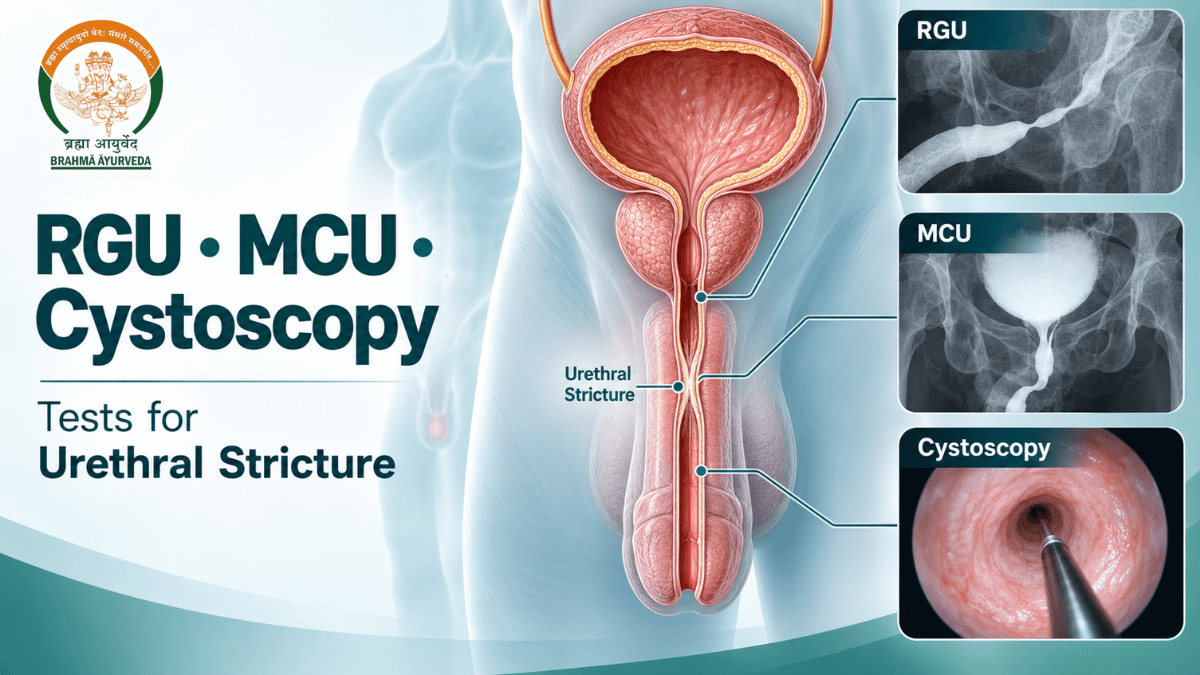
If you have been diagnosed with urethral stricture, you may hear your doctor mention tests such as RGU, MCU or cystoscopy.
These names can sound complicated, especially when you are already dealing with urinary symptoms such as a weak urine stream, difficulty passing urine, straining or incomplete bladder emptying.
The important thing to understand is that these tests do different jobs. They are not necessarily required for every person with urinary symptoms or every patient with urethral stricture.
The choice of investigation depends on your symptoms, medical history, previous treatment, suspected location and severity of the narrowing, and what information the doctor needs to make the next clinical decision.
The European Association of Urology (EAU) includes clinical assessment, urine testing, uroflowmetry, post-void residual assessment, imaging and endoscopy among the tools that may be used in the evaluation of urethral stricture disease.
Let’s understand these three tests in simple terms.
What Is RGU?
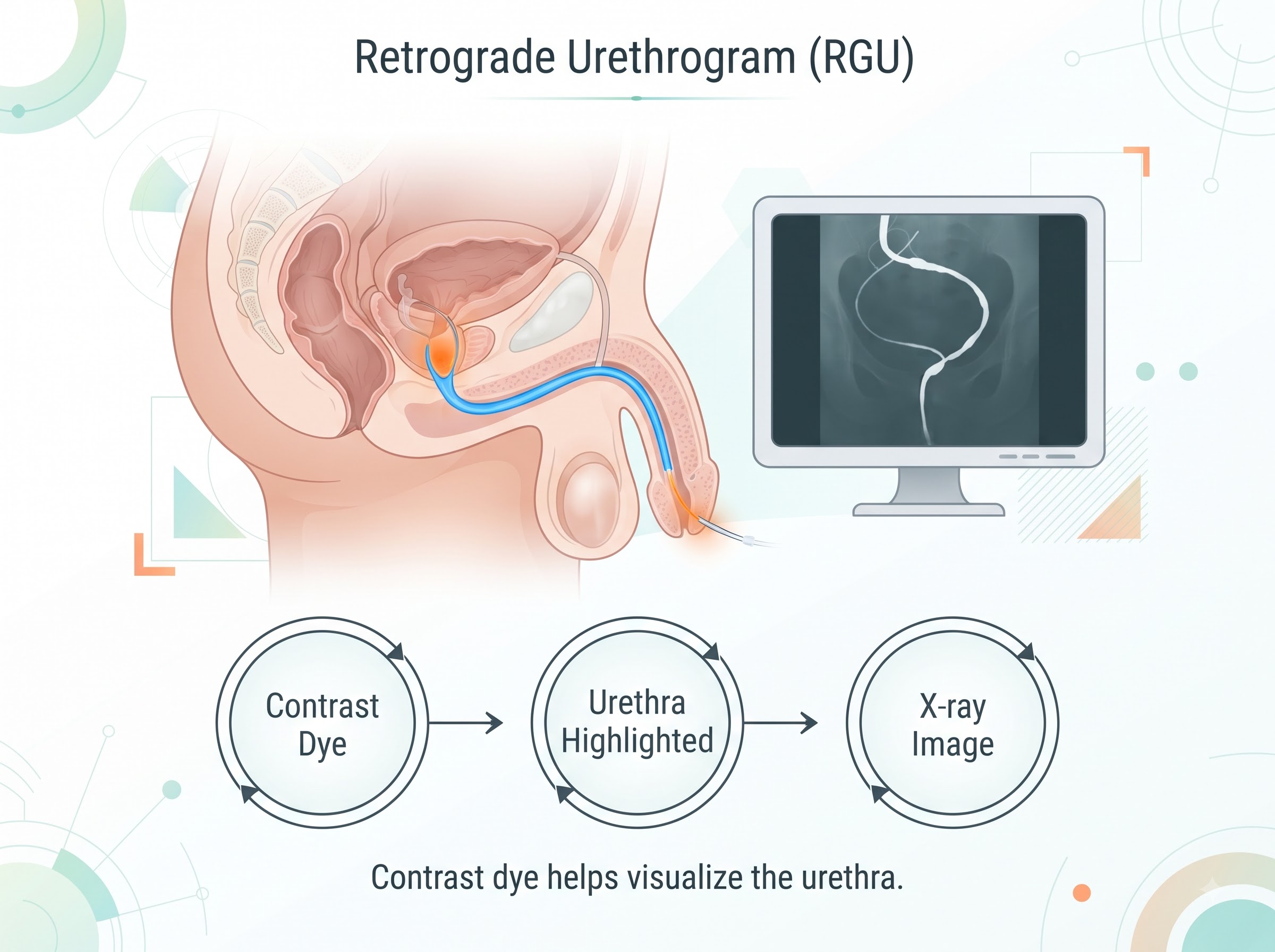
RGU stands for Retrograde Urethrogram.
It is an X-ray-based imaging test used to examine the urethra and is particularly useful when a doctor suspects a urethral stricture.
During an RGU, contrast material is introduced into the urethra. X-ray images are then taken to see how the contrast moves through the urethra.
This can help show:
- Whether a narrowing is present
- Where the narrowing is located
- Approximately how long the narrowed segment is
- How severe the narrowing appears
- Whether there are other abnormalities that may be relevant
The EAU describes retrograde urethrography as a widely used investigation for assessing the presence, location and length of urethral strictures.
The AUA Urethral Stricture Disease Guideline also notes that RUG, with or without VCUG, is used to delineate stricture location, length and severity in men.
Why is RGU useful in urethral stricture?
A urethral stricture is essentially a narrowing caused by scar tissue. Simply knowing that urine flow is reduced does not tell the doctor exactly where the narrowing is or how long it is. An RGU can provide anatomical information that helps answer these questions. This becomes particularly important when planning treatment.
However, RGU has limitations. For example, it may underestimate the true length of a stricture, particularly in some severe or nearly blocked strictures.
This is one reason why test results should always be interpreted together with the patient’s symptoms and clinical findings.
How is an RGU test performed?
The exact procedure can vary slightly between centres, but generally:
- You will be positioned for the X-ray examination.
- The opening of the urethra is cleaned.
- A contrast liquid is introduced into the urethra.
- X-ray images are taken while the contrast outlines the urethra.
- The images are reviewed to look for narrowing or other abnormalities.
You may experience some pressure or discomfort during the test.
The EAU notes that possible risks of urethrography include discomfort, infection, contrast-related reactions and radiation exposure, although the test is commonly used and generally well tolerated.
What Is MCU?
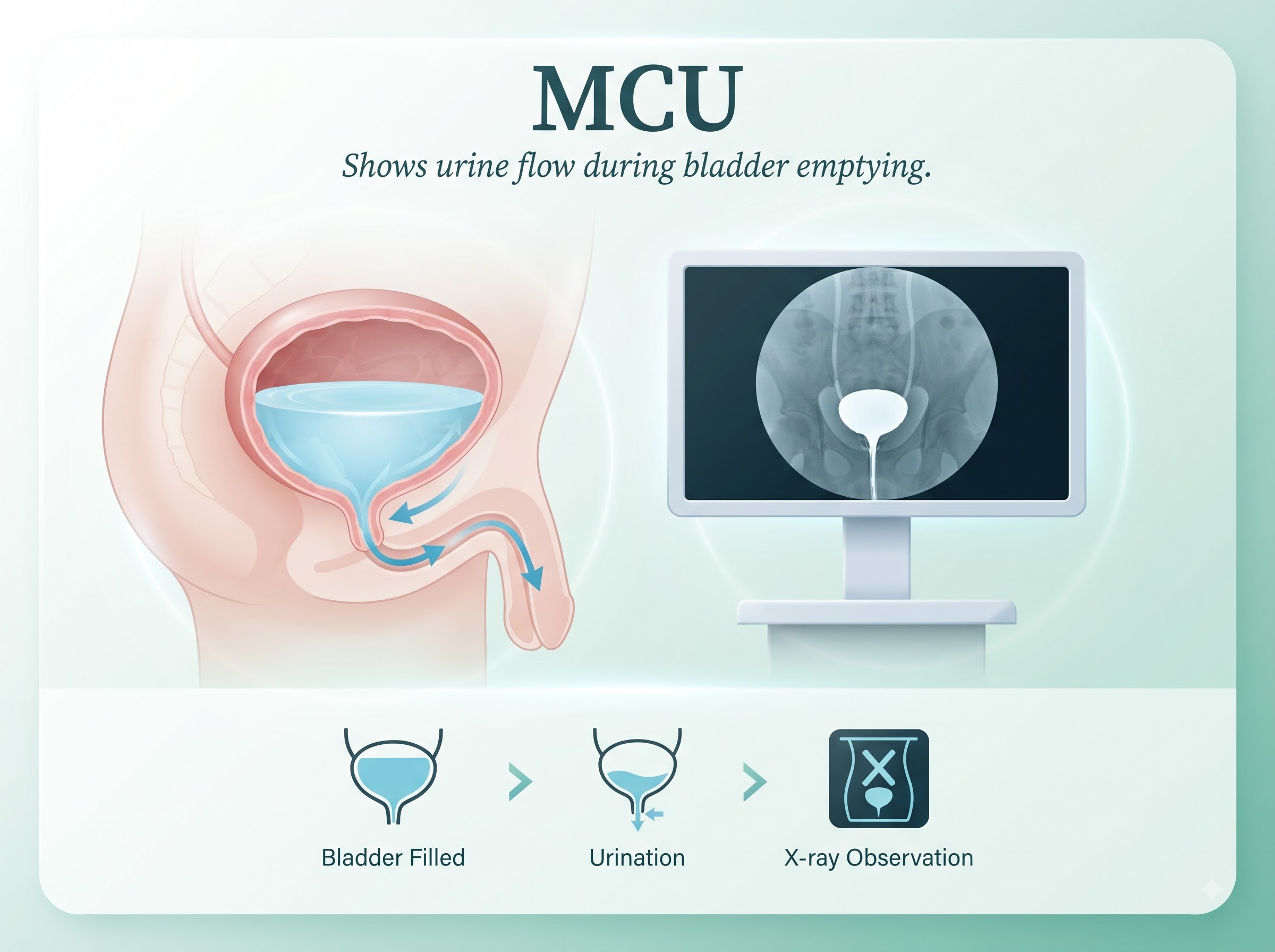
MCU stands for Micturating Cystourethrogram.
It is also commonly referred to as a VCUG (Voiding Cystourethrogram) in medical literature.
Unlike RGU, which looks at the urethra while contrast is introduced in a retrograde direction, MCU/VCUG involves imaging while the patient is passing urine.
The bladder is filled with contrast, and X-ray images are taken during urination.
This allows the doctor to observe the bladder and urethra during the process of voiding.
Why is MCU used?
MCU can provide additional information when the doctor needs to understand what happens to the urethra during urination.
In urethral stricture disease, it can be particularly useful in certain situations where the urethra beyond a severe narrowing cannot be adequately assessed with RGU alone.
For example, the EAU recommends combining RUG with VCUG when assessing nearly obliterative strictures, stenoses and pelvic fracture urethral injuries, because it can help visualise the urethra beyond the narrowed segment and improve assessment of the stricture length.
Does everyone with urethral stricture need MCU?
No.
This is an important point.
MCU is not a routine test that every patient with urethral stricture needs.
It may be recommended when the doctor needs additional anatomical information that cannot be obtained adequately from the initial evaluation or RGU.
The investigation should therefore be selected according to the individual clinical situation.
How is an MCU test performed?
During an MCU:
- The bladder is filled with a contrast solution.
- X-ray images may be taken as the bladder fills.
- You are then asked to urinate.
- Images are taken during urination.
- The images help the doctor assess the bladder outlet and urethra during voiding.
Because the test involves bladder filling and urination during imaging, some people may find it uncomfortable or unfamiliar.
Your healthcare team should explain the procedure and why it has been recommended in your particular case.
What Is Cystoscopy?
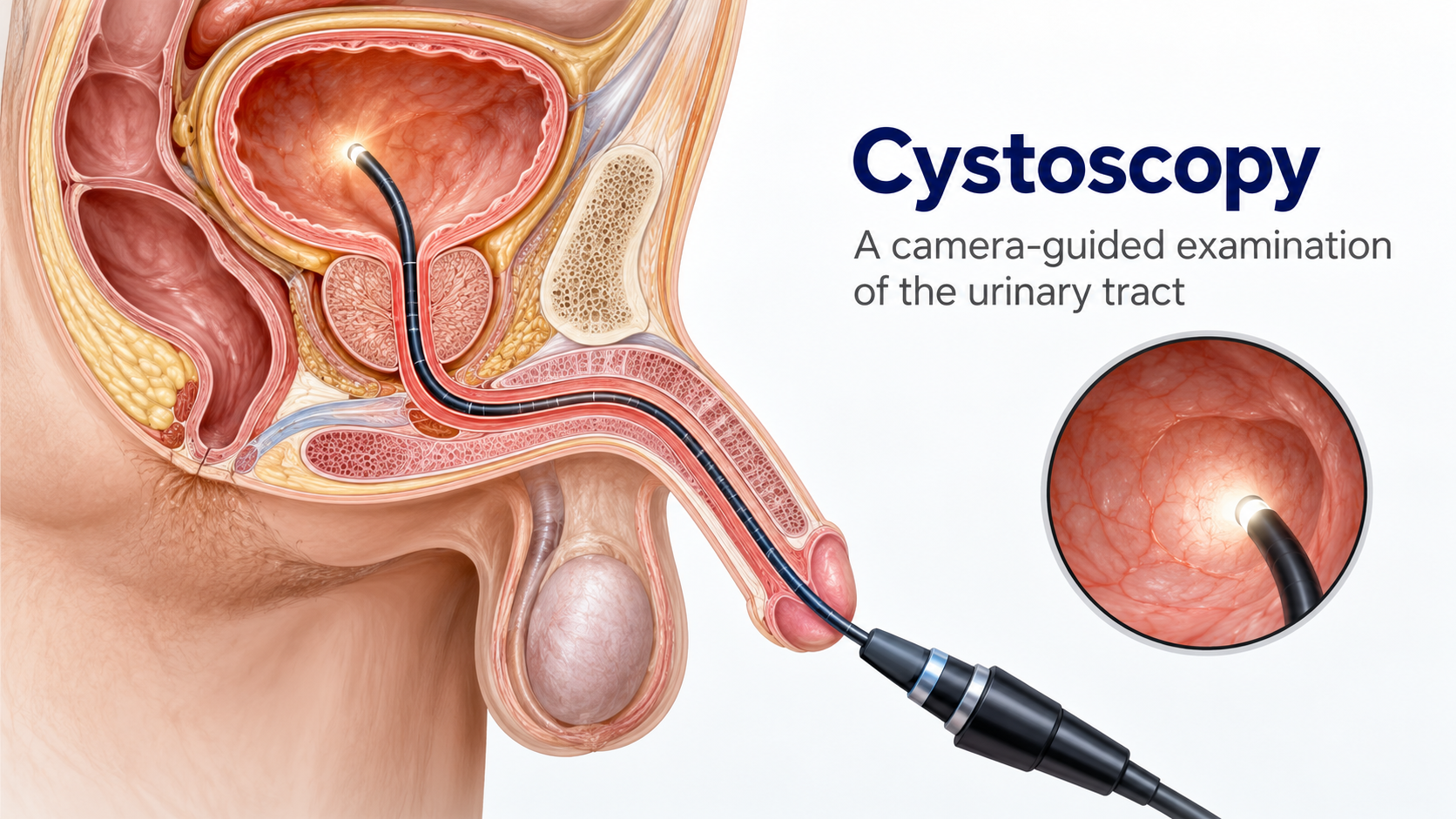
Cystoscopy is an endoscopic examination of the urethra and bladder.
Instead of using X-ray images, a doctor uses a thin instrument called a cystoscope to look directly inside the urinary passage.
Depending on the type of cystoscope and the clinical situation, the examination may allow the doctor to see:
- The urethral opening
- The urethra
- The area of narrowing
- The bladder outlet
- The inside of the bladder
- Other abnormalities such as bladder stones in selected cases
The EAU states that cystourethroscopy can reliably detect the presence of a urethral stricture and can be used as an adjunct to imaging when additional information is required.
Why might cystoscopy be recommended?
One advantage of cystoscopy is that it allows direct visualisation of the urethral passage.
If a narrowing is present, the doctor can see the narrowed area directly.
Cystoscopy can also help when the doctor wants to evaluate other possible causes of urinary symptoms or examine the bladder.
However, cystoscopy also has limitations.
For example, a standard cystoscope may not be able to pass through a very narrow stricture. It may therefore confirm the presence of narrowing without providing a reliable measurement of the complete stricture length.
This is why cystoscopy and urethrography can sometimes provide complementary information rather than one test replacing the other.
How is cystoscopy performed?
A cystoscopy generally involves:
- Cleaning the urinary opening.
- Applying a local anaesthetic gel or using another appropriate form of anaesthesia depending on the procedure.
- Gently passing the cystoscope through the urethra.
- Examining the urethra and, when possible, the bladder.
- Removing the instrument after the examination.
You may feel some pressure or discomfort during or shortly after the procedure.
Your doctor will explain what type of cystoscopy is appropriate and what preparation is required.
RGU vs MCU vs Cystoscopy: What Is the Difference?
The easiest way to understand these tests is to look at what each one is designed to show.
| Test | What it does | How it examines the urinary passage |
|---|---|---|
| RGU | Shows the urethra and helps assess narrowing, location and length | X-ray + contrast introduced into the urethra |
| MCU / VCUG | Shows the bladder and urethra during urination | X-ray + contrast while voiding |
| Cystoscopy | Allows direct visual examination of the urethra and bladder | Camera / endoscope |
These tests are not interchangeable in every situation.
The appropriate test depends on what the doctor needs to know.
Which Test Is Best for Urethral Stricture?
There is no single test that is automatically “best” for every patient.
If the main question is the location and length of a suspected stricture, RGU can provide important anatomical information.
If the narrowing is very severe and the urethra beyond it needs to be evaluated, RGU may sometimes be combined with MCU/VCUG.
If direct visual confirmation of a narrowing or examination of the urethra and bladder is needed, cystoscopy may be useful.
The European Association of Urology (EAU) recommends RUG for assessing stricture location and length in men being considered for reconstructive surgery, and recommends combining RUG with VCUG in nearly obliterative strictures, stenoses and pelvic fracture urethral injuries. Cystourethroscopy is recommended as an adjunct when further information is required.
Do You Need All Three Tests?
Not necessarily.
This is one of the most common misunderstandings about urethral stricture investigations.
A patient may need one investigation, while another patient may need a combination of tests.
The decision can depend on:
- Your symptoms
- Previous urinary procedures or catheterisation
- Previous urethral stricture treatment
- Suspected location of the narrowing
- Severity of obstruction
- Results of uroflowmetry
- Post-void residual urine
- Findings on earlier imaging
- Whether treatment or surgery is being considered
A comprehensive evaluation may use several types of information rather than relying on one investigation alone.
Can Uroflowmetry Confirm Urethral Stricture?
No.
This is worth remembering, especially if you have already had a uroflowmetry test.
Uroflowmetry measures how urine flows during urination. A reduced flow rate or prolonged plateau may occur with urethral stricture, but uroflowmetry alone cannot confirm that a stricture is present.
The EAU specifically notes that although a reduced maximum flow with a prolonged plateau can be characteristic of urethral stricture, flow patterns are not considered a reliable screening tool for detecting stricture by themselves.
You can read more about the test in our guide to uroflowmetry.
What Happens After RGU, MCU or Cystoscopy?
The test is only one part of the diagnostic process.
Your doctor will usually consider the investigation results alongside your symptoms, medical history, physical examination and other relevant findings.
For example, a patient with a weak urine stream may have urethral stricture, but reduced urine flow can also occur for other reasons.
If urethral stricture is suspected, understanding the cause, location, length and severity can help the doctor decide what treatment options may be appropriate.
You can learn more about the condition in our detailed guide to urethral stricture symptoms and causes of urethral stricture.
What If the Reports Show a Urethral Stricture?
A diagnosis of urethral stricture does not mean that the same treatment is suitable for everyone.
Treatment depends on factors such as the location and length of the stricture, severity, previous treatments and the overall clinical situation.
If you have already undergone RGU, MCU or cystoscopy, it is useful to keep the complete report and images, rather than relying only on a summary or a single measurement.
These records can help the treating doctor understand your condition more accurately.
If you are exploring treatment options, you can also read our detailed information about Ayurvedic treatment for urethral stricture and learn more about Uttar Basti therapy in urethral stricture treatment.
Important: Do Not Choose a Test Based Only on the Name
It is understandable to search online for “best test for urethral stricture” and compare RGU, MCU and cystoscopy.
But the more useful question is:
what information does my doctor need from the investigation?
RGU, MCU and cystoscopy each provide different information.
One may be sufficient in one patient, while another patient may need more than one investigation.
A proper evaluation should therefore be individualised rather than based on a fixed testing routine.
Frequently Asked Questions
1. Is RGU painful?
RGU can cause some pressure or discomfort because contrast is introduced into the urethra. The level of discomfort varies from person to person.
2. Is RGU the same as MCU?
No. Both use contrast and X-ray imaging, but they examine the urinary passage differently. RGU evaluates the urethra by introducing contrast retrogradely, while MCU/VCUG takes images during urination.
3. Is cystoscopy painful?
Cystoscopy can cause some pressure or discomfort. Local anaesthetic gel is commonly used for flexible cystoscopy, while the type of anaesthesia depends on the specific procedure.
4. Does every urethral stricture patient need cystoscopy?
No. Cystoscopy may be useful when direct visual assessment is needed, but it is not automatically required for every patient. The EAU describes cystourethroscopy as an adjunct when further information is required.
5. Does every patient need MCU?
No. MCU/VCUG is used selectively. It can be particularly useful when additional information is needed in severe or nearly obstructive strictures and certain pelvic fracture urethral injuries.
6. Can RGU tell the complete length of a stricture?
RGU can provide an important estimate of stricture length, but it may underestimate the true length in some cases.
7. Can uroflowmetry diagnose urethral stricture?
No. Uroflowmetry can identify abnormal urine flow patterns and may raise suspicion of obstruction, but it does not confirm urethral stricture by itself.
Final Takeaway
RGU, MCU and cystoscopy are different investigations used to answer different clinical questions.
RGU is particularly useful for imaging the urethra and assessing the location and length of a stricture. MCU can provide additional information during urination and may be useful in selected severe or complex cases. Cystoscopy allows direct visual examination of the urethra and bladder.
Most importantly, not every patient needs all three tests.
The right investigation depends on the individual’s symptoms, history, suspected anatomy and the information required for further management.
If you have been advised to undergo RGU, MCU or cystoscopy and are unsure why the test has been recommended, discuss the purpose of the investigation with your doctor before deciding.
For patients seeking an evaluation of urethral stricture, Brahma Ayurveda provides consultation for urinary and urethral conditions. Online consultation is also available through the Brahma Ayurveda consultation page.